Showing posts with label myths. Show all posts

Saturday, December 2, 2023

Haunted Hikes Book Recommendation

Happy December everyone! I have another book recommendation for you guys. 

Haunted Hikes is a collection of mysterious stories from North America's National Parks. The target reader for this book is a person who plans to go hiking in National Parks and visit all the paranormal hot spots. In my case, this book reads more as a warning of places not to visit. Every time I read a new story I would say "Yeah, I'll be avoiding that area. Thanks for letting me know!" Still I have found this to be a fun historical read.


The author of this book is Andrea Lankford. Among other tough jobs, she has a background in search and rescue as a park ranger. I can only imagine what it's like to do that job. The word "harrowing" comes to mind. It isn't clear whether she is a skeptic or a believer in relation to some of these stories, but I can tell that she has an open mind and also a sense of humor. That sense of humor can be seen on her dedication page:

Each of the hikes is rated by a skull system. Believe me, the stories that are rated four skulls go with places where some baaaaad stuff happened. 

You might want to click on this pic to see it larger. I got a kick out of this.

The contents page shows all the areas of North America that she covers. This book is well organized for the traveler who wants to reference a specific park.

So, the book is organized like this: Different regions of North America, then under each region the National Parks that are there. Each National Park section has a story or two. After the stories comes a description of what to expect if you'd like to hike the areas described, like miles and difficulty. A simple map accompanies each hike. I just picked a random map to give you an idea. As you can see, I picked an "Easy" hike that kids can enjoy with a one skull rating. I guess I picked a tame one. 


I'm not sure I described that in a way that makes sense, so I'll give an example. Say you're interested in the California and Hawaii chapter. There's a section in there about Joshua Tree National Park. In that section are several stories from the park. There's one story about "Skull Rock" and after that there is a description of the hike around that area. Part of that description is above, along with the map. So you get a nice description of the loop you'd be walking and a few details to look out for if you plan to search for UFOs in the area.

I think this example I shared is actually a hike I'd be up for. Some of the hikes are long and strenuous, are in the territory of dangerous animals, or are sites of old crime scenes. For the most part the crimes are very old, but still. As I said at the beginning, thanks for the warning! 

You don't have to be a hiker to enjoy this book. If you're into history or the paranormal, that's enough. And this is a funny book, especially considering some of the subject matter. 

If any of you have some haunted hike stories of your own, I'd love to hear them! Reading this book, I'm not sure how any National Park isn't teeming with ghosts. 

Saturday, April 21, 2012

There's more than one way to kill a vampire


Recently I got around to watching The Satanic Rites of Dracula. Which is also known as Count Dracula and his Vampire Bride, along with many other titles. Whatever you want to call it, this was the last in the series of Hammer Dracula movies starring Christopher Lee. This movie offered a nice conclusion to the series, as well as a few new vampire rules. Such as running water instead of holy water. Evidently, in this story just having water running from a tap is enough to battle a vampire!


Although, as I recall in Dracula AD 1972, Johnny Alucard (That's Dracula backwards) is also killed by being thrown into a running shower. Just a regular running shower like you have in your bathroom. (That's him in the above photo.)

This got me thinking about vampire rules. Somehow, the rules differ depending on the movie! A really noticeable modern difference are the vampires in Twilight who are able to magically be out all day long. I'm not the only person who's noticed how the rules change from one vampire movie to the next. Here is a chart that lists vampire traits and how they change with each movie:

List of vampire traits in folklore and fiction
 
The traits on this list are mostly physical characteristics. I'm going to focus on the rules for battling a vampire. Some of the original rules seem pretty obvious (like repelling a vampire with a cross) but I needed to research some of the others to understand their origins.

Let's start with the mirror rule. A vampire should not show a visible reflection in a mirror. Many movie vampires have been exposed as being more than just weird men when they walk past a mirror.


You may have heard about the practice of covering mirrors in a house after a person has died. There are religious reasons why some people do this, but those aren't related to this topic. I'm talking about how the Victorians covered all the mirrors in their houses with black fabric after a loved one's death. The mirrors would have to stay covered so long as the deceased's body was in the house. It was thought that if a person saw their reflection in a mirror while the body was there, they would be the next to die. These people morbidly believed that the ghost of the recently deceased might be hanging around and waiting to take more souls with them to the afterlife. Evidently a mirror could help them do so. Reflections in a mirror were believed to be a projection of a person's soul. That's why vampires don't have reflections; they have no souls!

Also, according to some folk stories, a mirror facing outward from your door can repel a vampire from your home.

How about garlic? The scent of garlic is sometimes enough to turn off regular people, let alone vampires. So this one always made good sense to me.


Garlic has been used to drive away evil spirits since ancient times. It was considered a purifying agent. Some people would hang it on their doors to repel vampires, like that mirror idea I mentioned. There was even a theory that anyone who didn't like garlic was a vampire!

The classic vampire weapon is a stake through the heart. I've heard other old stories about corpses not only being staked but decapitated. I guess decapitation was an extra step to make sure a vampire couldn't return.


Decapitation always sounded smarter to me. I mean, why should it matter if vampires are staked in the chest? It's not like an undead creature has a beating heart. I did find some references to them being staked in the stomach in some parts of Serbia. This was done to get rid of the "bloated" demon in the stomach. Well, that's one way of looking at a bloated stomach. I imagine that people with beer bellies were in trouble...

I also just read that vampires were staked in the mouth in some areas of Russia and Northern Germany. I'm going to assume that this was done only to corpses. Some people say vampires are staked in the chest to secure them into their coffins. Meaning that the stake would go through the vampire and somehow lodge into the bottom of the coffin to keep the vampire in place.

Holy water makes sense as a weapon against vampires. It could easily be carried around and would naturally be hated by an evil, undead creature.


A really memorable moment for me in The Lost Boys is when the kids decide to collect holy water from a church. In canteens. While a baby is being baptized. I couldn't find a video of that moment to share, but I did find a video clip showing what happens with the collected holy water:


Crosses make sense to me in the way that holy water does. Some people believe that only a crucifix (a cross with Jesus on it) will do. From the movies I've seen, a cross quickly made from even two popsicle sticks or whatever is on hand will do the trick. As I said earlier, the rules seem to change with every retelling of a vampire story.


This next rule isn't mentioned in too many vampire films. It's the rule that the vampire must sleep in a coffin that is filled with the dirt from where he came. Supposedly if you were to switch his old world dirt with new local dirt, he could not sleep in his coffin. This is why we see Count Orlok traveling around with several coffins full of dirt in Nosferatu. I guess he was being extra careful to have homeland dirt on hand. Although, in a lot of movies I've watched, the vampires aren't even sleeping in coffins, let alone dirty ones.


I'm not sure why the dirt switching is a such a threat to vampires. What's the worst that this could do to them? Maybe if the vampire has enough sleepless days, he goes crazy like sleepless humans do.

One more famous threat to vampires is daylight. This appeared to be the most serious threat in the past, although as I mentioned things have changed with Twilight. It used to be that if a vampire was out during the day, he'd just go *poof* and disappear into a cloud of smoke. Or a pile of bones and ashes. In the photo below you can see Count Orlok being killed by a sun ray that's shining through the window.


Some types of the disorder, Porphyria have been suggested as a reason for the vampires-hating-sunlight theory. Some kinds of Porphyrias cause an extreme sensitivity to sunlight. This theory attempts to explain the connection between this condition, and the old stories about vampires who fear the sun. Perhaps long ago, a person suffering from Porphyria would have been suspected as a vampire. Some people say that Vlad the Impaler suffered from acute Porphyria. This obviously would have helped spur the rumors of vampires fearing the sunlight. 

This video gives a nice (if dramatic) overview of how to kill a vampire.


I kept waiting for this guy to introduce an episode of Masterpiece theater or something.

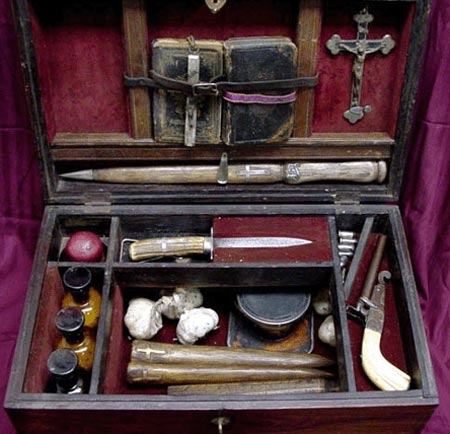
If you'd like to cover all the bases, you might want to pick up a vampire killing kit. This actual antique kit has everything you would need to kill a vampire. This particular kit was made during the 1800s and went for around $15,000 at auction.


Many vampire kits were made during the 1840s. Bram Stoker's Dracula came out in 1897. So, this kit probably wasn't a novelty item based on a book. Between Dracula having been written 50 years after this kit was made, and the high quality of materials used, I'd guess this was seriously created for killing vampires! Many more vampire killing kits (both old and new) can be found on my new favorite site:

Vampire Killing Kits on Pinterest

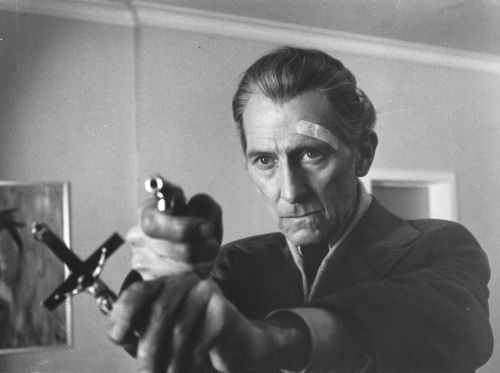
I'd love to see some old photos of the people who carried these kits! I imagine they'd look a little like this:


Friday, April 13, 2012

Feeling superstitious? Fight bad luck with these...


This blog post was inspired by what I discovered on Pinterest today. Many of you are probably aware of my new Pinterest obsession. For the past week or so, I've been posting #TheDailyPinBoard every day on Twitter. Today's board was chosen in honor of Friday the 13th. It's a collection of mysterious looking jewelry pieces and talismans from around the world:

http://pinterest.com/coreyackelmire/very-superstitious/

Each of these was meant to protect the wearer from various curses and bad luck. Looking at this pin board got me thinking about the many ways we try to protect ourselves from superstitions, and the superstitions we invent to protect ourselves in everyday situations. I'm going to share a few favorite protective pieces with you and give some background information on each.


This first image incorporates two powerful symbols of luck: a four-leaf clover and a key. It's considered lucky to find a four-leaf clover in nature, although they are very rare. The leaves on a four-leaf clover stand for the following: faith, hope, love, and luck. Everyone could use a little of each!

As for the key, it's a symbol that offers luck in different ways, depending on how your culture views it. For instance, in Japan a very powerful lucky charm can be made from tying three keys together. If these three keys are worn, the wearer will be able to unlock the doors that lead to love, health, and wealth.


The evil eye is a pretty straightforward symbol. Think of it as a mirror you're wearing to reflect any evil thoughts or mean intentions back on the person directing them at you. The evil eye is often seen in jewelry. Commonly it takes the form of the glass eyes above. I made a pair of earrings from wooden evil eye beads. They kind of resemble goofy, Muppet eyeballs in this photo:


All the beads were a little uneven, so lets just say they're always looking in different directions. I made them as a cute little eyeball fashion statement, but a part of me does wonder if they ward off negativity!


The wishbone is a standard symbol of good luck. We've all heard how the person who breaks off the larger side of the wishbone will receive good fortune. An unbroken wishbone symbolizes the promise of good luck.


Any kind of jewelry that includes the cat's eye gemstone is considered lucky, especially in India. It's supposed to help remove obstacles from your life, ward off the evil eye, ghosts, and negative influences. Some people wear it for good luck when gambling, because it is considered the go-to gemstone for games of chance.


Frogs seem to symbolize luck in nearly every culture around the world! They're said to bring good health, attract true friends, and help bring long-lasting love. Some Native American tribes of the Southwest U.S. believe that frogs helped bring fire to people, and some native Aborigines believe that frogs help bring rain to their crops. So they're pretty much all purpose good luck!

 
You might be surprised to learn that pigs are a symbol of luck. I had kind of a heads up on this one because I've seen lucky marzipan pigs for sale around here at Christmas time. The pig is considered lucky in some European countries, especially Germany. Good luck tokens in the shape of pigs are said to bring wealth, good fortune and prosperity.


The lucky horseshoe is a symbol we're all familiar with. I never knew why it was considered lucky, until doing a little research just now. Evidently, horseshoes are associated with the strength and dependability of horses. That and the "U" shape is supposed to hold good luck inside of it forever. Some people say that a horseshoe pointing upward will gather luck, while one pointing downward will shower you with luck. Either option sounds good to me!


This gorgeous amulet pendant was made in England, somewhere between 1540-60. The above photo shows the pendant from the front, while the photo below shows the back of the amulet. 


You can see that the stones on the back of this pendant would be in direct contact with the wearer’s skin. According to medieval beliefs, this would help the stones' magical properties soak into the wearer. Renaissance pendants were often made as amulets to protect against danger.


This pin is an example of "Witch's Heart" jewelry. Isn't it beautiful? You can tell that it's a Witch's Heart piece, because the side of it is indented. This shape has been used in jewelry since the 15th century, but gained popularity in Scotland in the 17th century. These hearts were sold in Edinburgh, Scotland as tokens to ward off evil spirits and protect loved ones. Tiny Witch's Hearts were often pinned to a baby's blanket as protection.

These hearts are being added to my jewelry wishlist. With any luck, I'll find one of these at an estate sale some day!

I've saved one of my favorite pieces for last. This is a lucky Chatelaine. It was made in Germany somewhere between 1870-1880.


I recognized this as something cool when I first saw it, but I had no idea what a Chatelaine was. It turns out that these were suspended from a belt or waistband. Many of these held useful household items like scissors, thimbles, keys, etc. Chatelaines were a useful way for housekeepers to carry items throughout the house in the 19th century. Think of it as a much cooler fanny pack.

Evidently, the woman who wore this Chatelaine had a different purpose in mind. She had more than enough symbols on this to keep her safe! That, and I bet people always heard her approaching.

You could wear any of these objects to feel safe, or just opt out of leaving the house on Friday the 13th. Evidently, a lot of people do!


As I read on the Friday the 13th Wikipedia page:

According to the Stress Management Center and Phobia Institute in Asheville, North Carolina, an estimated 17 to 21 million people in the United States are affected by a fear of this day making it the most feared day and date in history. Some people are so paralyzed by fear that they avoid their normal routines in doing business, taking flights or even getting out of bed. "It's been estimated that [US] $800 or $900 million is lost in business on this day".
 
So, whether or not you're outfitted with protective jewelry, today might be a good day to hit the mall. You'd probably encounter a stress free traffic and shopping situation!

I ran across endless amounts of lucky symbols to share, so it was hard to choose just a few. Do any of you have a piece of jewelry or clothing you find lucky to wear?


Have a happy and safe Friday the 13th!

Friday, March 16, 2012

Walk with me to the dark side of the woods

When you think about the magic of Ireland, what images pop into your mind? Do you imagine green rolling hills, leprechauns, fairies, or rainbows? Any of these would be an interesting focus, but I'm going to take you down a darker path. It's the kind of path that leads through a shadowy, fog-filled forest. A forest where you hear mysterious noises that you can't quite see the source of. I'm leading you to the darkest realm of this forest so I can introduce you to the not-so-nice creatures of Ireland.


As we walk under this somber canopy of trees, we hear a distant shriek. Could this be the sound of a banshee? The banshee's voice is said to resemble something between a woman's scream and the screech of an owl, and that is exactly what we hear.


You've probably all heard of the banshee. Sometimes she appears as a beautiful woman and sometimes she looks horrifying. Either way, she is always a shrieking omen of death.

Someone claiming to be a banshee, foretold the murder of King James I of Scotland in 1437, and there have been banshee reports in Ireland as recently as 1948! So, who knows? One of them might still be here. Let's quickly get away from the shrieking.

Oh, what's this? A little cottage in the middle of the woods! This looks like a safe banshee-free zone, right?


Wait. This is a dark, haunted forest. Maybe we should peek in the window first, to make sure nothing scary is inside. Aww... What a sweet sight. It's a mother leaning over her baby's cradle. The baby shifts back and forth slowly in its bed. Suddenly it lifts its head, and... eww. That's no baby!


It's a lumpy, yellow thing with a bad attitude. It's a fairy changeling! Sometimes the fairies take a baby and leave a changeling in its place. They have many reasons for doing so, but the main reason in Irish stories is envy. Looking at a baby with envy is putting it in danger. If too many people envy the baby, it's more or less like signing it away to the fairies.

There is only one way to change it back into a baby: Throw the changeling into a fireplace. It will then leap up the chimney and the baby will be returned. Yeah... you better be really sure that what you have is a changeling before throwing it into the fire!


Adult humans also run the risk of becoming changelings, if looked upon with enough envy. In fact, in the year 1895, Bridget Cleary was killed by her husband, because he believed she was a changeling. Or so he said.

Let's leave this terrible scene. I can't bear to watch the changeling get thrown into a fireplace!

If these woods weren't haunted, we could be having a relaxing nature walk. There's so much wildlife here to enjoy. I assume those are squirrels rustling in the dead leaves, and birds chirping from the trees overhead. Not to mention that lovely...um, horse/goat thing with the gold eyes that's been watching us.


This is the form the Pooka (Irish for goblin) has decided to take at this time. The Pooka is a shapeshifter; it can appear as a goat, horse, rabbit, or dog. It most commonly takes the form of a large black horse with golden eyes. It can be either a good or bad creature, depending on its mood. There are stories of the Pooka being kind, and yet it also likes to confuse and scare people. The only day one can be sure the Pooka will be nice is on November 1st. That's Pooka Day. Obviously, it's now March, so it's difficult to know what we're dealing with. Let's just quickly walk past this creature and hope it doesn't bother us...

Even though we walked away from the Pooka, the sound of galloping horse hooves is still around us. Has the Pooka decided to follow us? No, we are being followed by the kind of creature that makes a Pooka seem harmless. It's The Dullahan, who looks very similar to someone you might find in Sleepy Hollow.


The Dullahan may look like the standard headless horseman we are familiar with, but there are some differences. The main difference is that instead of searching for a head, the Dullahan carries his. A strange feature of the head is that it has the color and consistency of moldy cheese. That and he carries a whip that is made from a human spine. So you don't want to get close to him, purely because you'd be grossed out if you did. Of course, there are far more deadly reasons to avoid him. It's said that if the Dullahan stops his horse and calls out a person's name, they will die at that exact moment.

One more disgusting feature! The Dullahan does not like it when people watch him. If you do, he will throw a bucket of blood in your face! Yes, he carries a bucket of blood along with his cheesy head and spine whip. He's a multitasker like that. So, now that we've caught sight of The Dullahan, let's just run the other way and not bother him. As if I even needed to tell you that... 

After running through the tangled trees, we see something more inviting. It is a gorgeous, glittering figure with iridescent wings.  It is the Lianhan Shee.


The Lianhan Shee is a beautiful fairy that is sort of like a siren. She basically puts men under her spell to the point where they give up everything for her. The only way to be free from her spell is to refuse her advances. Very few men do. If they do manage to reject her, the tables are turned and she does their bidding. It's time to go, before any of the men in our group are tempted by her...

Speaking of someone the guys might want to avoid, a Dearg-Due is known to lurk in these woods. The Dearg-Due is an Irish female vampire.  I've seen her referred to as "the red blood sucker". However, some legends say that she isn't so much interested in blood, as she is sucking the souls out of people's bodies.


The only way to hold her at bay is to pile stones on her grave. Evidently, if you pile on enough stones, it's inconvenient for her to dig out of the dirt. Placing something heavy on top of a vampire's coffin is a pretty practical solution! So, let's pile a few stones on her resting place, and make our way out of the woods.

* A quick vampire theory worth sharing:

Some people argue that Bram Stoker's Dracula was based upon the Dearg-due. Dracula was written during Ireland's great "Celtic Revival". Some believe that Stoker took the name "Dracula" from Dreach-Fhoula, pronounced droc'ola. This word happens to mean "bad or tainted blood" in Irish. At the very least it's an interesting coincidence.

As we make our way to a clearing in the forest and look through the trees, we see a large body of water and an approaching ship. Suddenly a fog appears out of nowhere! It's the work of The Grey Man (Far Liath).


He has created this fog in the hopes of causing a ship wreck. The fog grows thicker and we blindly manage to walk through it on our way out of this place. After walking for some time, we hear a sound in the distance. It's hard to be certain, but it sounds an awful lot like a ship crashing against the rocks.

Now that you have survived the haunted forest and scary Irish creatures, you can breathe a sigh of relief and have a happy St. Patrick's Day!